+604-507 6303
sinengaun96@gmail.com
+604-507 6303
sinengaun96@gmail.com
+604-507 6303
sinengaun96@gmail.com

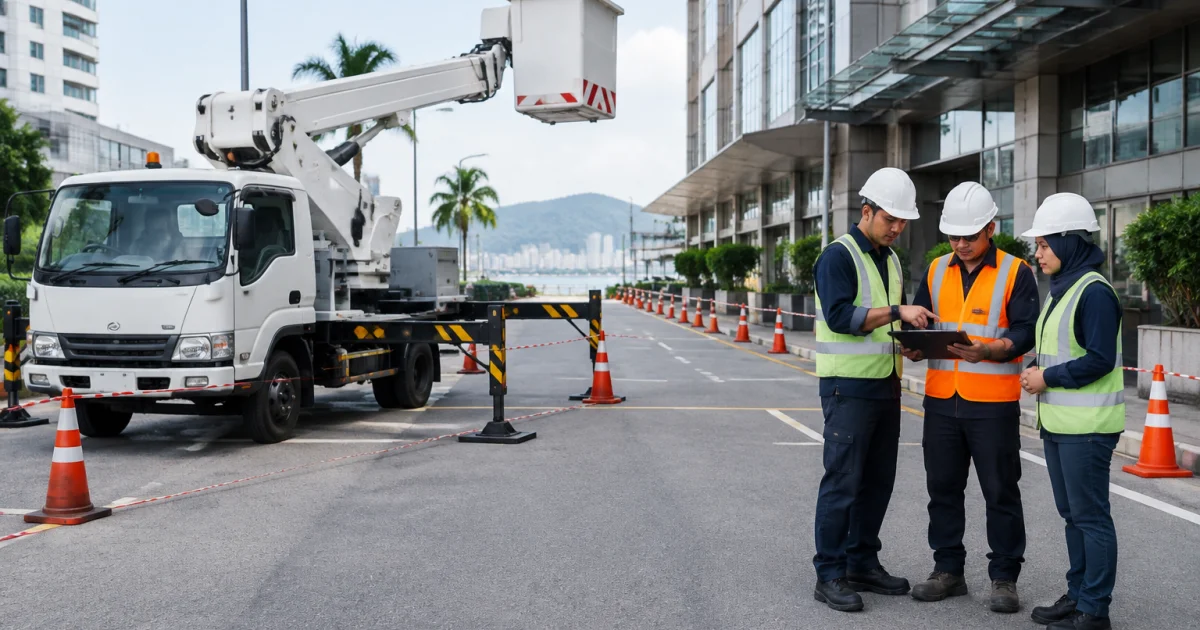
When people talk about a “skylift delay”, they often blame the operator, the traffic, or the machine. My view is simpler: most downtime is self-inflicted. It happens when a site books a skylift like it’s just a truck that shows up, lifts, and leaves—without treating access planning, ground conditions, reach geometry, and scheduling as hard constraints.
If you’re arranging Skylift Penang work for façade maintenance, signage installation, lighting or cabling on a commercial building, you’re usually fighting the clock: tenant hours, weather windows, permit timing, and crews that can’t do anything until the platform is in the right spot. This article is an opinion—based on what repeatedly causes jobs to stall and a set of practical checks you can run before you confirm a booking.
Many sites evaluate access by looking at the final parking spot only. But most delays start earlier: the approach road, turning radius, overhead restrictions, and the ability to position the unit without blocking a live lane or a building entrance.
Common ways access planning fails:
Downtime reducer (practical step): do a simple route check. Send the supplier (or your own supervisor) three photos and one sketch: (1) the approach road, (2) the intended set-up area, (3) the workface looking outward, plus a sketch showing cones/barriers and where people will walk. It’s not about perfection—it’s about surfacing “we can’t actually park there” before the machine arrives.
In skylift rental discussions, “ground condition” is usually reduced to: “It’s concrete, so it’s fine.” I disagree. Ground risk is about load distribution and hidden weakness, not just whether the surface looks solid.
Where jobs commonly stall:
Downtime reducer (practical step): treat the set-up zone as a “no-surprises rectangle.” Walk it and mark: soft edges, covers, slopes, and any surface transitions (asphalt-to-concrete). If you’re on a deck or near underground services, ask the building rep for guidance on heavy vehicle placement. If you can’t obtain confirmation, adjust the work plan (different position, different access method, or reschedule) instead of hoping the operator can “make it work.”
This is the most expensive misunderstanding: teams book based on working height alone. But the job is rarely straight up; it’s usually up-and-over something such as canopy, parapet, set-back façade, planter, fence, or a drop-off where you can’t park close. That’s reach, not just height.
Two patterns I see often:
Downtime reducer (practical step): measure like a skylift, not like a tape measure. Before booking, capture four numbers:
If you only provide a single “metres high” figure to a skylift company, you’ll often get a unit that technically reaches the height but cannot work efficiently at that offset. Then the crew spends hours repositioning, or the supplier has to swap equipment—both are pure downtime.
Skylift work is extremely sensitive to timing because it interacts with everything: traffic management, tenant access, delivery windows, and other contractors. In my opinion, “supplier lateness” is often a downstream effect of unclear site readiness or last-minute changes.
Examples of coordination conflicts that waste half a day:
Downtime reducer (practical step): appoint one “skylift marshal” (often the site supervisor) whose job is to protect the set-up window. They confirm: barriers are ready, access is clear, work crew and materials are on-site, and the work sequence is agreed. Without a single owner, the skylift becomes the most expensive waiting area on wheels.
To reduce back-and-forth and prevent mismatched equipment, send a short “job card” message when requesting a quote for skylift rental. It should be specific enough to surface constraints, but not so long that it gets ignored.
This is also where local language appears in real purchasing: many sites ask for sewa skylift quickly by WhatsApp. That’s fine—speed matters—but the job card details are what prevent the “arrive, realize, re-plan” cycle.
Use this table as a final sense-check. It’s not a legal or engineering document, just a practical way to catch the usual downtime triggers early.
| Risk area | What goes wrong on-site | What to verify before booking | Downtime symptom if missed |
|---|---|---|---|
| Access route | Unit can’t enter, can’t turn, or can’t stop where planned | Approach road width, turning area, overhead obstructions, entry timing | Long waiting time, forced relocation, job aborted |
| Set-up zone control | Other vehicles/materials occupy the space needed for outriggers | Cones/barriers plan, exclusion zone, a named person to keep area clear | Operator idle time while site “clears space” |
| Ground bearing & surface hazards | Surface cracks, pavers shift, drains/manholes sit under outriggers | Surface type, slope, wet conditions, covers/voids, deck loading limits | Repositioning, refusal to set up, equipment swap |
| Height vs outreach | Machine reaches height but can’t reach over parapet/canopy from available parking | Height, horizontal offset, obstacle clearance, required buffer from façade/traffic | Multiple moves, incomplete work area coverage |
| Scheduling & readiness | Permits not ready, crew/materials missing, workface not prepared | Confirmed time window, tenant/building approvals, materials on-site, work sequence | Paid time burned before work starts |
If you take one idea from this: don’t treat a skylift as a commodity. Treat the booking as a short project with constraints. The machine is only productive when the route is clear, the ground is suitable, the reach is correct, and the set-up window is protected.
When those basics are handled, skylift work is one of the fastest, cleanest ways to access a façade or elevated M&E point—often faster than assembling and moving scaffolding for small-to-mid scope jobs. But when those basics are ignored, the platform becomes a visible symbol of wasted hours.
Your best lever to reduce downtime is not arguing on the day of work. It’s providing clear site information upfront, verifying the geometry (height and outreach), and appointing one person to own readiness. Do that, and you’ll find most “skylift delays” disappear.
Send the target work height, estimated horizontal set-back, any obstacles (awnings, parapets, cables), the preferred set-up zone, surface type (asphalt, concrete, pavers or deck), and your time window. Add 3 photos (approach road, set-up area, workface). This reduces the risk of the wrong reach or a last-minute equipment change.
Usually not. Working height can look correct on paper while outreach is insufficient once you’re forced to park further away due to traffic lanes, driveways, or pedestrian routes. Measure both height and horizontal offset, plus what you must clear (canopy/parapet) so the supplier can match the correct boom geometry.
Most delays come from site readiness: the set-up zone is occupied, barriers and exclusion zones aren’t prepared, approvals aren’t confirmed, or the crew/materials aren’t ready at the workface. A skylift is productive only when it can deploy outriggers and start work immediately within the permitted window.
Interlocking pavers, hidden drains/manholes, soft edges near landscaping, sloped surfaces, and podium or car-park decks with unknown loading limits. Even “solid-looking” ground can be unsuitable if outrigger loads concentrate over weak points. Walk the set-up zone and flag covers, voids, and surface transitions before confirming the booking.
Lock down the sequence: keep the set-up area clear in advance, stage tools and materials, confirm building management access, and appoint one supervisor to coordinate traffic/pedestrians. Share a short job card with the skylift company early so the correct unit and timing are planned for the first attempt, not after repositioning.
Sin Eng Aun Mobile Crane Sdn. Bhd. supports Penang projects with skylift rental services and practical on-site coordination. Share your target height, set-back distance, photos of access and the set-up zone, and your preferred time window—we’ll help you match the right equipment and reduce avoidable downtime.